22 min read
What Is ADHD: From Definition to Diagnosis and Treatment for Parents and Adults
ADHD (attention-deficit/hyperactivity disorder) is not laziness or a parenting failure; it is a neurodevelopmental trait rooted in differences in brain development. Dr Sid Ryu, a child and adolescent psychiatrist, lays out the three presentations, how diagnosis works in Korea, why we say "remission" rather than "cure," and what to do in the first 30 days when symptoms are suspected, from both a parent's and an adult's perspective.
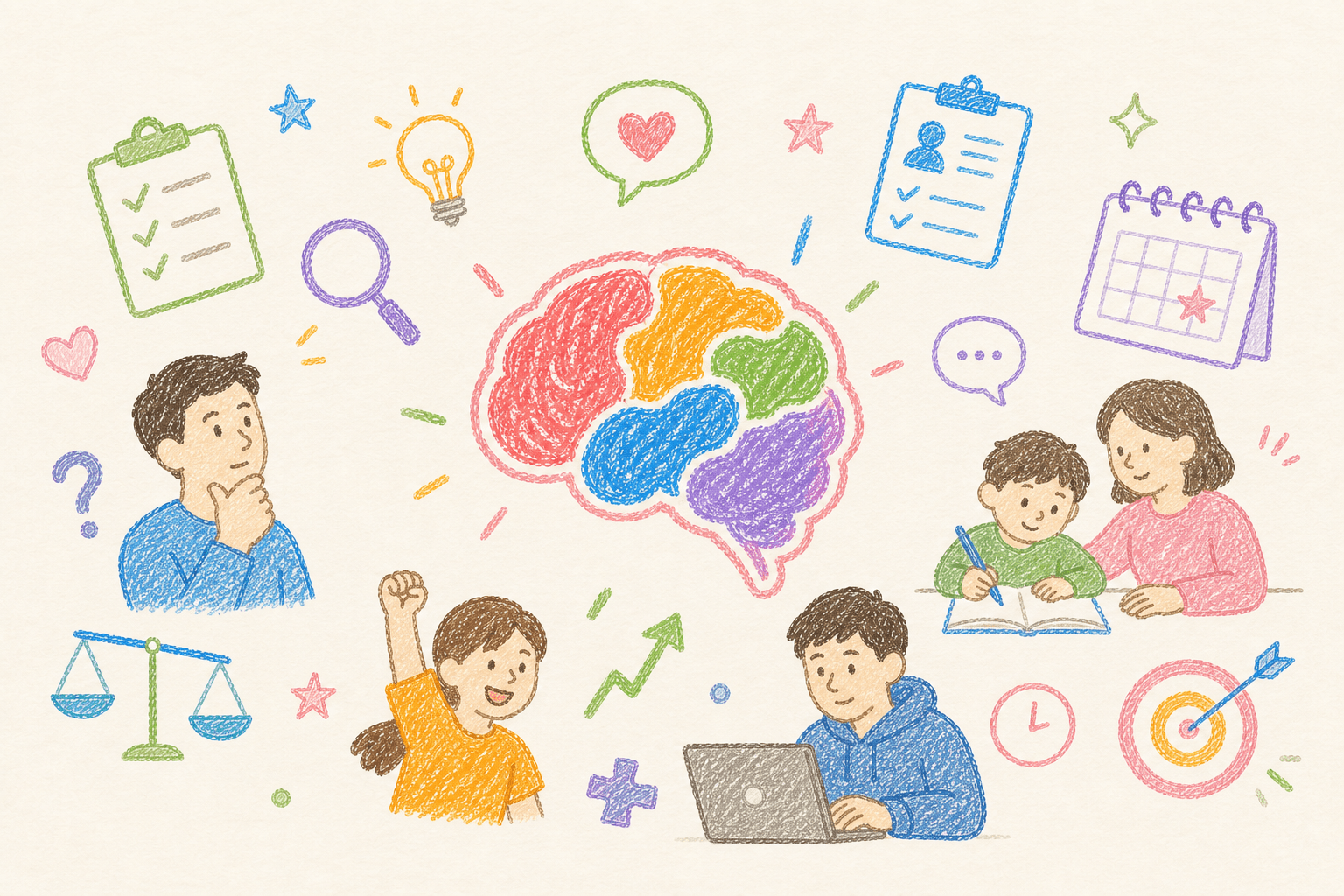
Key takeaways
ADHD (attention-deficit/hyperactivity disorder) is a neurodevelopmental trait rooted in differences in the development of the brain regions involved in attention and in regulating impulse and activity. It is not laziness or a parenting problem.
There are broadly three presentations: predominantly inattentive, predominantly hyperactive-impulsive, and a combined form. Even with the same ADHD, it looks different from child to child and from adult to adult.
Diagnosis does not end with self-screening. Self-screening is a starting point; confirmation goes through a specialist's clinical evaluation. This piece helps both parents and adults organize that first step.
When someone in the clinic asks "what exactly is ADHD," I do not start by reciting a symptom list. Instead I ask back: "What is the scene that worries you most right now." Parents picture the battle that repeats every morning; adults picture the things they missed in a meeting. Understanding ADHD begins from that specific scene.
This piece puts a name to that scene. I will lay out what ADHD is, how it appears, and how diagnosis and treatment flow, from both a parent's and an adult's perspective. I will go one step deeper than the symptom checklist you commonly find in a search, and explain it through what I have seen in the clinic over 20 years.
What ADHD is, starting from a one-line definition
ADHD stands for Attention-Deficit/Hyperactivity Disorder, and the official Korean name is “주의력결핍 과잉행동장애”. The phrase "attention deficit" holds the core. The ability to pay attention, the ability to stop an impulse, the ability to adjust your activity level to the situation. It is a neurodevelopmental trait in which the development of the brain regions responsible for these three proceeds at a different pace and pattern than peers.
I want to make two things clear here. First, ADHD is not a matter of will or effort. The U.S. Centers for Disease Control and Prevention (CDC) also describes ADHD as a neurodevelopmental disorder related to brain development. Second, a parent's parenting style does not create ADHD. Parenting can affect how intensely symptoms show, but it is not the cause of ADHD itself. I often meet parents in the clinic who blame themselves, asking "is it because I raised them wrong," and you can set that self-blame down.
Why the same ADHD looks different: three presentations
ADHD is not a single picture. The American Psychiatric Association's diagnostic criteria (DSM-5-TR) divide it into three presentations by where the center of gravity of symptoms sits.
1. Predominantly inattentive: hyperactivity is not prominent, but sustaining attention is hard. The child sits quietly but the mind is often elsewhere, forgets supplies, and struggles to carry a long task to the end. Because they do not talk loudly or run around, they look like a "well-behaved child" and are often found late. The so-called "quiet ADHD" is close to this.
2. Predominantly hyperactive-impulsive: hard to stay still, hard to wait one's turn, with words or actions coming out ahead of thought. Relatively noticeable at younger ages.
3. Combined: inattention and hyperactivity-impulsivity appear together. This is the most common in the clinic.
In adulthood, hyperactivity decreases on the surface and instead changes form into restlessness, procrastination, emotional ups and downs, and the pattern of starting only after being pushed against a deadline. That is why quite a few people did not know in childhood and first suspect it as adults.
How ADHD is diagnosed in Korea
Let me first clear up one of the most common misunderstandings. A high score on an online self-screening does not mean a diagnosis of ADHD. Self-screening is a starting point to gauge "whether it is worth seeing a specialist," not a diagnostic tool.
The actual diagnosis is a clinical evaluation that brings together several sources of information.
Interview: developmental history, life history, and the specific scenes of current difficulty.
Information from multiple settings: ADHD does not appear in only one place. For a child, what matters is whether difficulties are observed both at home and at school; for an adult, both at work and at home.
Rating scales and tests: standardized assessment tools are used as needed.
Checking co-occurring problems: anxiety, depression, learning disorders, and sleep problems often look like ADHD or occur alongside it, so these are examined together.
The reason for going through this process is clear. Sleep deprivation or anxiety can create a picture similar to ADHD, and conversely, real ADHD can be masked by another problem. The agent of diagnosis is not the test score but the specialist who reads that score within the person's context.
Why we say "remission" rather than "cure"
There is a question parents most want to ask. "Does it get better?" I answer this not with the word "cure" but with the word "remission."
In psychiatry, remission means a state where symptoms have settled enough that they do not greatly disrupt daily life. It also means we do not view ADHD as something to be "fixed back to original" like a broken machine. The brain goes through a process of forming and refining neural connections throughout the growth years. Thanks to this neuroplasticity, the weight of symptoms changes for many children as they grow. Of course, for some the trait continues into adulthood, and even then the goal of management is not "removal" but "keeping daily life running."
There is a reason I stress this view. Seeing ADHD as a "breakdown" makes both the child and the parent anxious. By contrast, looking at it through the developmental question, "what level of development are they showing now," shows you what to help with. A diagnosis is not a label but a map for helping that development.
When symptoms are suspected: what to do in the first 30 days
If you searched your way here, your heart is probably already heavy. Rather than rushing a big decision, let me lay out the realistic things you can do over the next month.
Observe and record two settings. For a child, home and school; for an adult, work and home. The more you write it as a scene, like "gets up and wanders around five minutes after starting homework" rather than "distractible," the more it helps the visit.
Use self-screening only as a starting point. Even if the result is at-risk, that is not a diagnosis but a signal that "it is time to see a specialist." The criteria that separate an energetic temperament from ADHD are laid out in energetic child or ADHD symptoms.
Check sleep first. It is common for sleep deprivation to create a picture similar to ADHD.
Book a specialist visit. What a parent should do within 30 days after receiving a self-screening result is laid out by stage in after an ADHD self-screening result.
From diagnosis to treatment: the whole flow
ADHD treatment does not come down to a single medication. Medication, behavioral and psychological therapy, environmental adjustment, and non-medication support are combined across several axes according to the child's age and symptom weight. What options exist and what to review when are laid out, with their evidence status, in ADHD treatment, from medication to non-medication devices.
Let me stress only one thing here. The goal of treatment is not to make a score normal but to build the strength for that child, that adult, to carry their own daily life. Medication and therapy are tools that buy time for that strength to grow, and at the center of the decision there must always be the consultation of the person, the family, and the treating physician.
Frequently asked questions (FAQ)
Q. Does ADHD go away on its own with age?
Some reach a remission state where symptoms settle enough as they grow, and for some the trait continues into adulthood. Which way is hard to predict in advance. So neither "wait and it heals" nor "it lasts a lifetime" is an accurate answer; assessing and helping with the present difficulty comes first.
Q. Can adults receive an ADHD diagnosis?
Yes. But adult ADHD looks different from childhood, often showing as restlessness, procrastination, or difficulty regulating emotions. We also look at whether there were traces of similar difficulty in childhood.
Q. If I score high on a self-screening, do I have ADHD?
No. Self-screening is a starting point to gauge whether to see a specialist. A confirmed diagnosis goes through a clinical evaluation that includes an interview, information from multiple settings, and a check for co-occurring problems.
Q. Is ADHD caused by a parent's wrong parenting?
No. ADHD is a neurodevelopmental trait related to brain development, and parenting is not the cause. Parenting can only affect how intensely symptoms show.
Q. Are "attention deficit" and ADHD the same thing?
Attention deficit is one of the core features of ADHD, and attention-deficit/hyperactivity disorder is the official name. When attention problems are prominent, it is classified as the predominantly inattentive presentation.
Q. Where do I get tested?
You can be tested at a child and adolescent psychiatry or a psychiatry clinic. The procedure and cost differ by institution and the scope of testing, so confirm in advance.
Q. If I get a diagnosis, will a lifelong label be attached?
A diagnosis is not a stigma but a map that tells you what to help with. Children and adults who receive appropriate support often do well, making the most of their strengths.
Notes on using medical information
This piece is for general information and does not replace the diagnosis or treatment of an individual patient.
A self-screening result is not a diagnosis. For a confirmed diagnosis and treatment, please follow the care of a child and adolescent psychiatrist or a psychiatrist.
Do not stop or reduce a currently prescribed medication on your own judgment. Any medication adjustment must be decided in consultation with the treating physician.
Related reading
- ADHD
- ADHD symptoms
- inattention
- ADHD diagnosis
- adult ADHD
- child and adolescent psychiatry

Dr Sid Ryu
Pediatric psychiatrist, SmartDream developer. Read more
Explore with AI
Keep reading
ADHD daily support
Quiet ADHD Symptoms: Easy-to-Miss Signs in Children and Adults, and a Self-Check Guide
ADHD daily support
High-IQ ADHD Symptoms: Why ADHD Can Be Harder to Spot in Brighter Children
ADHD daily support
Medikinet Side Effects, How It Differs from Concerta, and What Parents Should Check First