24 min read
After an ADHD Self-Screening Result, 4 Things Parents Should Do in the Next 30 Days
ADHD self-screening results from a community health center or community mental health welfare center. Being placed in a high-risk group does not mean a diagnosis. A clinician with 20 years of practice outlines a 30-day action guide for Korean parents: letting go of self-blame, two-environment observation journals, booking a first specialist visit, and five documents to bring into the consultation room.
Key takeaways
An ADHD self-screening is a tool that organizes signs of suspicion. It is not a diagnosis. Even if the result places a child in a high-risk group, that does not by itself mean ADHD.
In Korea, three self-screening tools are commonly used for free: the K-ARS, the Conners Rating Scale, and the ASRS. Each one applies to a different age range and measures different domains.
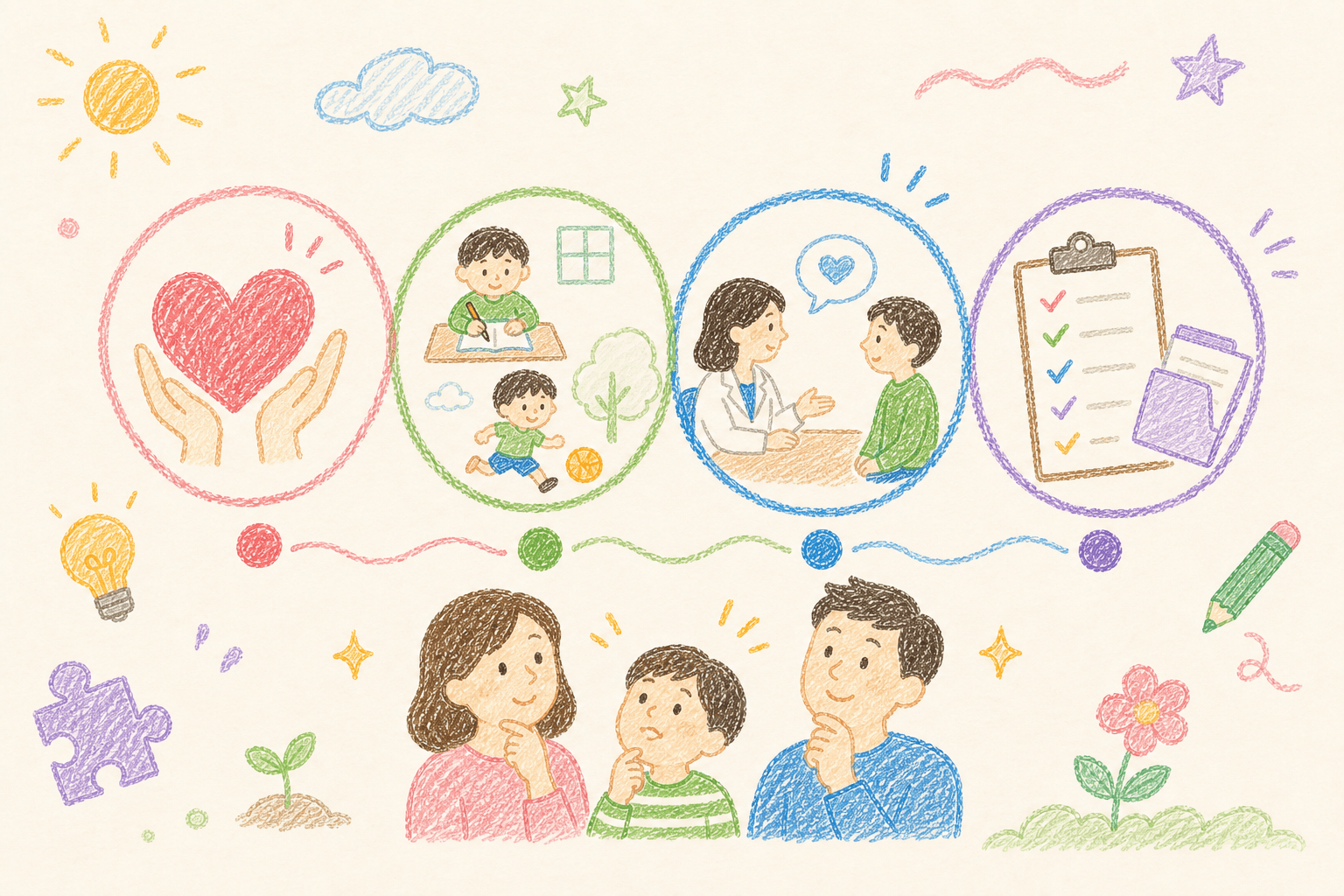
If a self-screening result raises suspicion, there are four steps parents can take in the next 30 days: clear away self-blame, keep a two-environment observation journal, book a first visit with a child and adolescent psychiatrist, and prepare five sets of materials to bring into the consultation.
A while ago a mother came into my consultation room. In her hand was a printed ADHD self-screening result from a community health center, with a stamp on it that read "high-risk group." Before she had even sat down, she said:
"Doctor, the result came back as high-risk. My child has ADHD, right?"
Over twenty years in practice I have seen this scene more times than I can count: a parent walking in with a single self-screening sheet, heart sinking. Often it is the weight of the result, more than the result itself, that keeps parents from taking the next step.
This article is a 30-day guide for caregivers who are holding such a result in their hand. It walks through what each of the three self-screening tools commonly used in Korea looks at, what their limits are, and how a parent can spend the 30 days after a high-risk result.
What an ADHD self-screening tells you, and what it does not
Let me make one thing clear from the start. A self-screening is a screening tool, not a diagnostic tool.
A screening tool is closer to a traffic light that tells you "from here on, a specialist needs to look at this." The diagnosis is the next stage you reach after that light. A red light does not mean the car is already stopped; in the same way, a high-risk result on a self-screening does not mean the child has ADHD.
In fact, the DSM-5-TR from the American Psychiatric Association defines an ADHD diagnosis as requiring all four of the following conditions (see the American Academy of Pediatrics ADHD Clinical Practice Guideline).
Six or more of nine inattention or hyperactivity-impulsivity symptoms (five or more for adults)
Symptoms begin before age 12
Symptoms appear in two or more settings (home, school, and so on)
Functional impairment lasting six months or more
A self-screening sheet only asks about the first of these conditions, and even that question relies on the memory of the parent or the person themselves. Conditions two through four require a clinician to combine interviews, school information, and developmental records.
Three self-screening tools commonly used in Korea
The self-screening sheets caregivers bring into my consultation room are almost always one of the following three.
1. K-ARS (Korean ADHD Rating Scale)
This is the Korean ADHD Rating Scale, a version of the American ADHD Rating Scale-IV standardized for the Korean clinical setting.
Who it is for: Children and adolescents ages 5 to 18
Who responds: Parent or teacher
Items: 18 items (9 inattention, 9 hyperactivity-impulsivity)
Official sources: Gangnam-gu Community Mental Health Welfare Center ADHD self-screening, Seodaemun-gu Community Health Center ADHD self-screening
Limits: Parent and teacher responses often diverge. Results based on only one respondent are less reliable.
2. Conners Rating Scale
The most widely used ADHD screening tool in the United States. Some clinics and community health centers in Korea also use it.
Who it is for: Ages 3 to 17
Who responds: Parent, teacher, or the adolescent themselves
Items: 27 items in the short form, up to 80 in the long form
Limits: Korean standardization data is limited. Some items do not align well with the Korean cultural context.
3. ASRS (Adult ADHD Self-Report Scale)
A WHO-developed self-report scale for adult ADHD.
Who it is for: Ages 18 and older
Who responds: The person themselves
Items: 18 items (6 in Part A, 12 in Part B)
Official source: Gangnam-gu Community Mental Health Welfare Center adult ADHD self-screening
Limits: Adults answer by recalling childhood symptoms, so recall bias is significant.
All three tools share one message. Do not look only at the score. What matters more than the score is whether the everyday pattern behind it has continued for more than six months.
When the self-screening points to a high-risk group: a 30-day guide
There is a 30-day flow I often recommend to caregivers in the consultation room. If a self-screening result raises suspicion, I would suggest walking through the following four steps over those 30 days.
Step 1 (Day 1 to 3): Step out of the self-blame trap
The first question that knocks on a parent's mind right after receiving a self-screening result is usually this one.
"Did I raise my child wrong?"
As discussed in this column in Psychiatric News, parenting does not directly create ADHD. According to a Korean family study reported by The Hankook Ilbo, if one parent has ADHD, the probability that the child has ADHD is around 57 percent. Genetic factors play a far larger role than upbringing.
At this stage I ask two things.
Share the result with a spouse or close family member instead of carrying it alone.
Do not make a decision the same day. Treat the first 24 to 72 hours as time to absorb the information.
Step 2 (Day 4 to 28): A two-environment observation journal
The "two or more settings" that the DSM-5-TR refers to usually means home and school. That is exactly why a self-screening sheet alone cannot produce a diagnosis.
Over these four weeks I recommend keeping two kinds of records.
Home journal (five minutes a day): Note the longest stretch of time your child focused on a single task that day, the most distracted moment of the day, and, if there were anger outbursts or impulsive behaviors, what triggered them and what followed.
School information (within one to two weeks): Politely request a meeting with the homeroom teacher and ask only three things.
How often the child gets up from their seat during class or disturbs other children
The rate at which the child finishes assigned tasks
The pattern of conflicts in peer relationships
These four weeks of material become the most important input for the next step, the first specialist visit.
Step 3 (Day 14 to 21): Book the first specialist visit
An ADHD diagnosis requires a consultation with a child and adolescent psychiatrist or a psychiatrist. You can find 12 nearby partner clinics on our clinic page.
When booking, it helps to ask two questions in advance.
Whether a diagnosis can be made at the first visit, or whether additional assessments are needed
Whether separate interview times are scheduled for the parent and the child
Most specialists do not make a diagnosis after a single visit. They typically combine two to three interviews with assessment tools such as the K-ARS, CAT, and Conners Rating Scale before reaching a judgment.
Step 4 (Day 22 to 30): Five sets of materials to bring to the first visit
If you bring the following five sets of materials into the consultation room, the doctor can make a far more accurate assessment.
The self-screening result sheet (with signature and date)
The four-week home journal from Step 2
Notes from the meeting with the homeroom teacher (a parent's written summary is fine if a formal note is difficult)
Developmental records: infant and toddler health check results, report cards by grade, past mental health records
Family history notes: any diagnoses or suspected diagnoses of ADHD, depression, or learning disorder in parents and siblings
When these five are in place, around 60 to 70 percent of the first visit's direction is already set.
After the 30-day guide
Even if the diagnosis is confirmed as ADHD, medication does not necessarily start right away. The decision about medication is made by weighing symptom severity, comorbid conditions, the child's age, and family preferences together.
There is a separate piece on treatment options after diagnosis. Is Medication the Only Option for ADHD? A 20-Year Clinician's View on 4 Non-Medication Choices and A Category Overview of ADHD Wellness Devices in Korea may also be useful.
Frequently asked questions (FAQ)
Q. Does a high-risk result on a self-screening automatically mean ADHD?
No. A self-screening is only a signal that a specialist assessment is needed; it is not a diagnosis by itself. Among children placed in a high-risk group, many turn out to have something other than ADHD, such as sleep disorders, learning disorders, anxiety disorders, or auditory processing issues, all of which can produce similar symptoms.
Q. Should I share the self-screening result with the school?
At the self-screening stage I do not recommend it. The more common pattern is to share with the homeroom teacher or school nurse after a first specialist visit confirms a diagnosis and school support is needed.
Q. Does a diagnosis affect insurance or future employment?
An ADHD diagnosis is recorded under health insurance code F90. Some insurance products may require disclosure during underwriting. If you are reviewing family insurance, it is worth checking with the insurance company about timing around diagnosis.
Q. What if the self-screening score is low but I see suspicious signs in everyday life?
Self-screenings focus mainly on inattention and hyperactivity. In Korea, quiet ADHD, the inattentive presentation, is often not picked up well by the score. If the signs in everyday life have continued for more than six months, I recommend a specialist visit regardless of the score.
Q. Can I take the self-screening one more time before deciding about a clinic visit?
Repeating a self-screening does not make the score more accurate. Keeping observation journals in two settings (home and school) over the same period of time helps the diagnostic accuracy far more.
A note on using this medical information
This article is for general information and does not replace the diagnosis or care of an individual patient.
ADHD diagnosis and medication decisions must follow the assessment of a child and adolescent psychiatrist or a psychiatrist.
SmartDream is a wellness device, not a medical device. It is not intended to diagnose, treat, mitigate, or prevent any disease.
Related reading
- ADHD 자가진단
- K-ARS
- ADHD 검사
- 부모 가이드
- 소아청소년정신과

Dr Sid Ryu
Pediatric psychiatrist, SmartDream developer. Read more
Explore with AI
Keep reading

ADHD daily support
Quiet ADHD Symptoms: Easy-to-Miss Signs in Children and Adults, and a Self-Check Guide

ADHD daily support
High-IQ ADHD Symptoms: Why ADHD Can Be Harder to Spot in Brighter Children
ADHD daily support
Medikinet Side Effects, How It Differs from Concerta, and What Parents Should Check First