23 min read
Energetic Child or ADHD Symptoms? 3 Criteria a Clinic Uses to Tell Them Apart
Lively behavior alone does not justify suspecting ADHD. Based on 20 years of clinical practice, this article lays out the three criteria (intensity, cross-setting consistency, and duration) used to separate ADHD symptoms from a simply energetic child, along with four shadow patterns that parents often miss.
Key takeaways
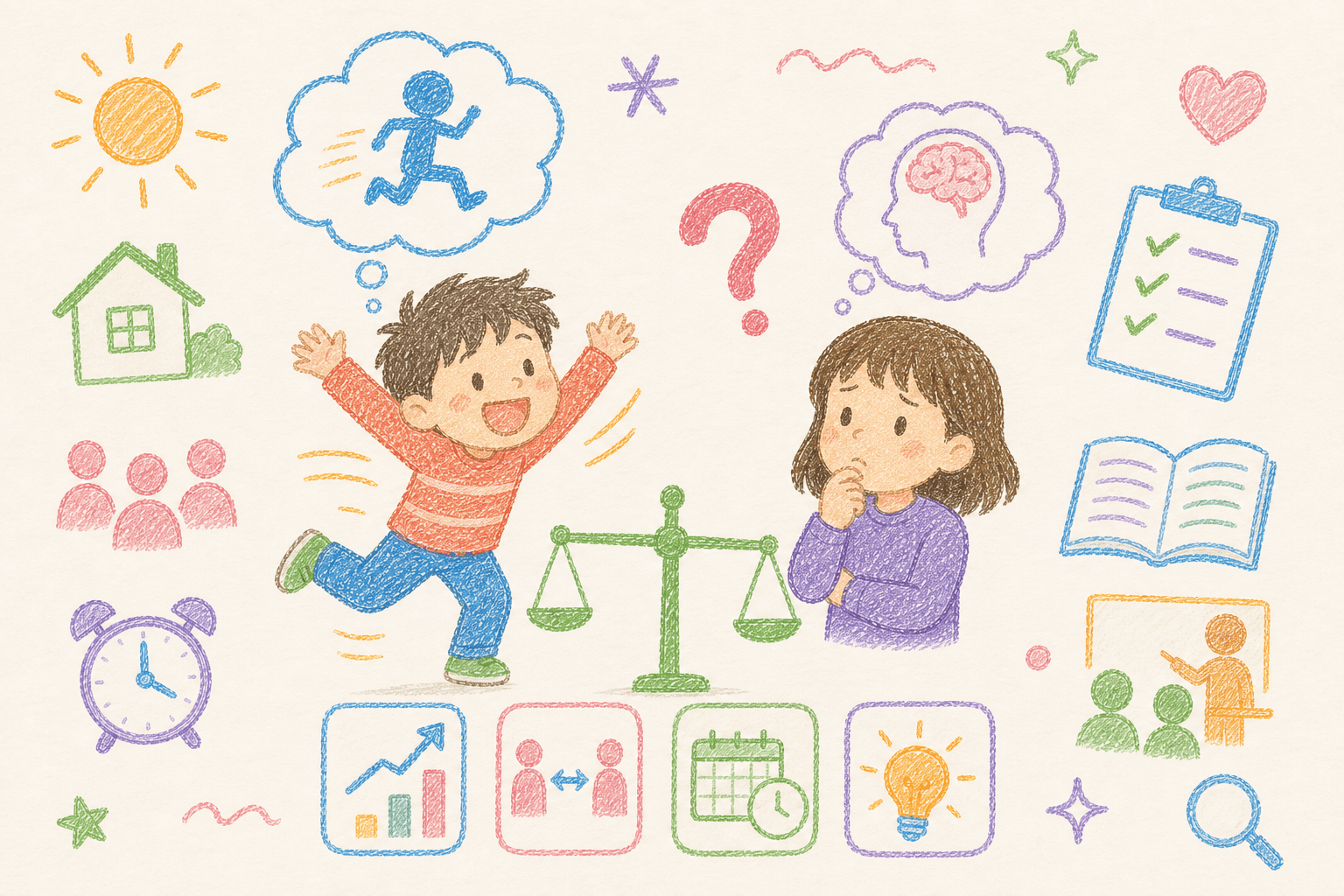
Being energetic is not the same as having ADHD. What a clinician looks at is not the behavior itself but its intensity, duration, and consistency across settings.
The 18 ADHD symptoms defined in the DSM-5-TR have to stand out clearly compared with same-age peers, appear together in both home and school settings, and persist for six months or more.
ADHD also exists without obvious lively behavior. Four shadows are often missed: quiet ADHD (the inattentive presentation), academic falling behind, peer conflict, and sleep problems.
Caregivers in my consultation room tend to raise one of two concerns.
"My child is so active, could this be ADHD? Should we get an evaluation?"
Or:
"My child is quiet and calm, but the teacher says they zone out and can't focus at school. Could that also be ADHD?"
The two situations look opposite, but in the clinic we use the same tools to evaluate both. The intensity of energetic behavior is not what defines ADHD. What matters is how consistently that behavior cuts across the child's everyday life.
Today I want to walk through what I have seen over 20 years in practice: the three criteria that separate ADHD from simple liveliness, and the four shadows that parents often miss.
The 18 core behaviors that make up "ADHD symptoms"
Let me begin with the clinical definition of ADHD symptoms. The DSM-5-TR from the American Psychiatric Association defines ADHD symptoms across two domains, with 18 items in total (see the American Academy of Pediatrics ADHD Clinical Practice Guideline).
Inattention (at least 6 of 9)
Often makes careless mistakes due to a lack of close attention in schoolwork or work
Has difficulty sustaining attention in tasks or play activities
Often does not seem to listen when spoken to directly
Often does not follow through on instructions and fails to finish schoolwork or work
Has difficulty organizing tasks and activities
Avoids or postpones tasks requiring sustained mental effort
Often loses items (pencils, books, phones)
Is easily distracted by external stimuli
Is often forgetful in daily activities
Hyperactivity-impulsivity (at least 6 of 9)
Often fidgets with hands or feet or squirms in seat
Leaves seat in situations when remaining seated is expected
Runs about or climbs in situations where it is inappropriate
Is unable to play or engage in leisure activities quietly
Is constantly on the move, often described as "driven by a motor"
Talks excessively
Blurts out answers before questions are finished
Has difficulty waiting their turn
Interrupts or intrudes on others
These items only become meaningful when they are clearly more frequent and clearly more intense than what is typical for the child's same-age peers.
Three criteria that separate simple liveliness from ADHD
When translating these 18 items into an actual diagnosis, the clinic looks at three criteria together.
1. Intensity: compared with the same-age average
A lively child also fidgets in their seat. They also bother friends at times. The difference comes down to frequency and intensity.
A phrase I often use in the consultation room is:
"Among the 25 classmates in your child's room, does your child's behavior stand out the most?"
If this is a hard question to answer as a parent, the most accurate person to ask is the homeroom teacher. They are the one who can directly compare your child with other children in the same environment.
2. Cross-setting consistency: at home and at school at the same time
This is the strictest condition the DSM-5-TR requires for an ADHD diagnosis. Symptoms must appear in two or more settings.
If a child is distracted only at home but fine at school, ADHD is less likely. The cause is more often something in the home environment (parenting approach, sibling dynamics, family stress), sleep deprivation, dietary patterns, or media use.
In the opposite case, if a child is distracted only at school but fine at home, it is worth looking first at learning disorders, auditory processing issues, or school environment factors such as seating and peer relationships.
3. Duration: six months or more
Symptoms have to continue for at least six months to meet the time threshold for an ADHD diagnosis. A pattern of being distracted for a month or two and then settling down again is more likely a temporary adjustment issue than ADHD.
In particular, the two to three months at the start of a new school year, or right after moving or transferring schools, can make any child temporarily restless as their environment changes. For this reason I recommend avoiding self-screening during those periods.
Four shadows parents often miss
Applying these three criteria can help separate ADHD from lively behavior. But in clinical practice, what we miss more often is the opposite pattern: ADHD without visibly lively behavior.
Shadow 1: Quiet ADHD (the inattentive presentation)
The DSM-5-TR divides ADHD into three presentations: predominantly hyperactive-impulsive, predominantly inattentive, and combined. The one most often missed in Korean clinics is the predominantly inattentive presentation, often called quiet ADHD.
These children rarely leave their seats and rarely make loud noises. Instead, they tend to show patterns like the following.
They often space out during class
The content of what they read does not stay in their head
They do not finish assignments, but they also do not act up
They often do not notice when a friend calls their name
This is especially common in girls. Parents and teachers often see only a "well-behaved child" and delay suspecting ADHD. Diagnosis can be put off until fourth or fifth grade, during which academic self-esteem can decline significantly.
Shadow 2: Academic falling behind
ADHD is not a problem of intelligence. But when attention deficits accumulate, academic achievement begins to fall behind that of same-age peers. The gap tends to widen from third or fourth grade, when the volume of schoolwork increases.
When a parent tells me "my child is smart but just doesn't study," there is often ADHD hiding behind that sentence.
Shadow 3: Peer conflict
A child with strong impulsivity cannot wait their turn and frequently interrupts their friends' activities. They themselves do not mean any harm, but the friends remember them as "the child who doesn't listen to me."
As the grades go up, the number of friends starts to shrink. As a result, the child can withdraw or, just as often, turn that frustration into anger.
Shadow 4: Sleep problems
According to Psychiatric News, 50 to 75 percent of children with ADHD also carry sleep problems. The reverse is also true. According to a report from Rehab News, about 40 percent of children initially suspected of having ADHD turned out to have sleep deprivation as the actual cause.
If a child is distracted, the sleep pattern over the same period must be checked together. Media exposure in the hour before bed, nighttime allergic rhinitis, or enlarged adenoids can produce patterns that resemble ADHD. A checklist is gathered in 7 Signs of Sleep Deprivation in Children.
Four reassuring signs for a lively child
There are also patterns where, despite being lively, the child is unlikely to have ADHD.
They can stay absorbed in an activity of interest for 30 minutes or more. Children with ADHD tend to have short attention spans even on activities they enjoy, and often leave their seats.
They stop the behavior when a parent firmly steps in. Children with ADHD often cannot be controlled even by firm intervention.
At school they are around the same-age average. If the liveliness only appears at home, it is more likely an environmental factor or within the range of normal development.
Sleep, meals, and friendships are stable. When ADHD is present, at least one of these three areas tends to be shaken.
If all four apply, you can take the liveliness as part of normal developmental variation rather than as suspicious of ADHD. That said, if the pattern shifts over time, I recommend reassessing.
Frequently asked questions (FAQ)
Q. My child is lively. Should I try an ADHD self-screening?
If the liveliness has continued for more than six months and the same pattern is reported at school, it is reasonable to try a self-screening. How to interpret the result and what to do next is laid out in 4 Things Parents Should Do in the 30 Days After an ADHD Self-Screening Result.
Q. Does firmly restraining a lively child make ADHD worse?
ADHD itself is not created by parenting style. But inconsistent restraint, scolding the same behavior on one day and letting it pass on another, makes it harder for the child to learn impulse control. Consistent rules and firm boundaries help.
Q. For the inattentive presentation of ADHD, are there options other than medication?
Beyond ADHD medication, options can include behavioral therapy, parent training, environmental adjustments, sleep and dietary management, and non-medication wellness support. A side-by-side comparison is in 4 Non-Medication Options for ADHD.
Q. If one sibling has ADHD, should the other one be evaluated as well?
According to a report by The Hankook Ilbo, when one parent has ADHD, the probability that a child has ADHD is about 57 percent. Risk among siblings is similarly elevated. If the other sibling has shown suspicious signs for more than six months, a visit to a specialist is recommended.
Q. My 4-year-old is very active. Can I do a self-screening now?
The K-ARS applies from age 5, and the Conners Rating Scale from age 3. That said, ages 4 to 5 fall within a particularly wide band of normal liveliness. It is more accurate to look at the self-screening result together with the results of developmental health checks.
A note on using this medical information
This article is for general information and does not replace the diagnosis or care of an individual patient.
ADHD diagnosis and medication decisions must follow the assessment of a child and adolescent psychiatrist or a psychiatrist.
SmartDream is a wellness device, not a medical device. It is not intended to diagnose, treat, mitigate, or prevent any disease.
Related reading
- ADHD 증상
- 조용한 ADHD
- 부주의 우세형
- 초등학생 ADHD
- 부모 가이드

Dr Sid Ryu
Pediatric psychiatrist, SmartDream developer. Read more
Explore with AI
Keep reading
ADHD daily support
Quiet ADHD Symptoms: Easy-to-Miss Signs in Children and Adults, and a Self-Check Guide
ADHD daily support
High-IQ ADHD Symptoms: Why ADHD Can Be Harder to Spot in Brighter Children
ADHD daily support
Medikinet Side Effects, How It Differs from Concerta, and What Parents Should Check First