52 min read
When You Worry About Concerta Side Effects: 7 Things Parents Can Check First (and Non-Medication Options)
A child and adolescent psychiatrist, Dr. Sid Ryu, organizes seven common side effects of methylphenidate-class ADHD medications such as Concerta (methylphenidate, long-acting) and Medikinet (methylphenidate, immediate and extended-release) from a clinical perspective. The article walks through the order in which to review them with a treating clinician instead of stopping medication on your own, along with the non-medication support options that can be considered alongside.
Key takeaways
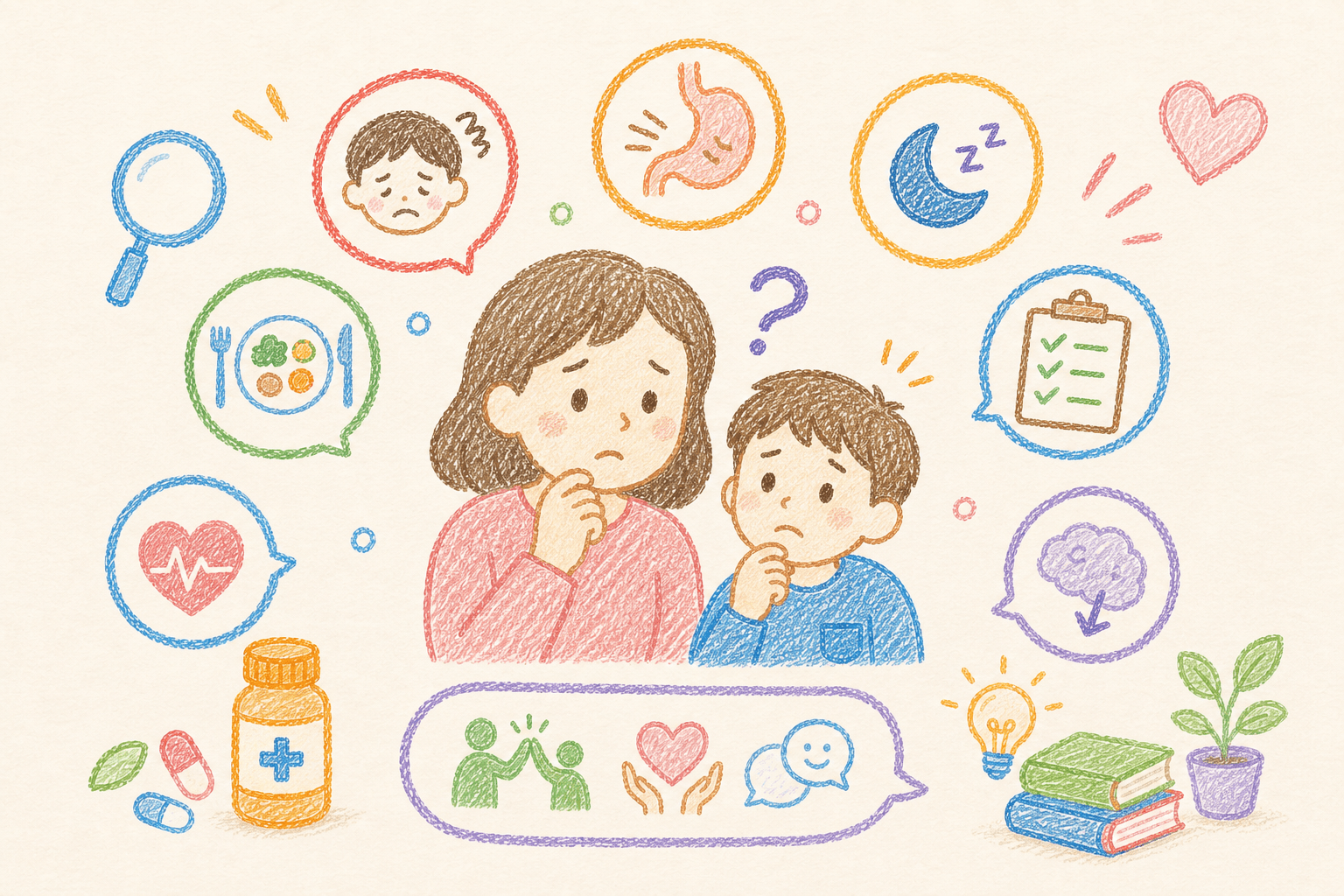
Concerta (methylphenidate, long-acting) and Medikinet (methylphenidate, immediate and extended-release) are central nervous system stimulants of the methylphenidate class and are first-line standard care for ADHD. The side effects most often reported in the clinic come down to seven: reduced appetite, difficulty falling asleep, emotional blunting, headache, the rebound effect, height growth concerns, and cardiovascular changes.
The most dangerous choice when side effects appear is for a parent to stop the medication on their own. The order of review I suggest in the clinic is: journaling, time-of-day adjustment, dose reassessment, medication change, and review of non-medication support options.
Before concluding that medication should be stopped or reduced, I recommend reviewing four non-medication options that can complement the same effects with your treating clinician: behavioral therapy, environmental adjustment, nutrition and lifestyle, and microcurrent-based wellness devices.
Hello. I am Dr. Sid Ryu, a child and adolescent psychiatrist.
One of the questions I most often hear from parents in the clinic is this.
"Doctor, is Concerta really the right medication for our child? I am so worried about the side effects."
The number of children and adolescents receiving ADHD care in Korea has grown quickly over the past few years. What has grown is not only the number of patients but also the hesitation of parents. The moment a parent receives the medication bag, questions surface in their head all at once: "What if it stunts their height?" "What if they cannot sleep?" "What if their personality changes?"
I do not dismiss medication. There is sufficient evidence, and used appropriately it is a safe form of care. Yet starting with an accurate understanding of side effects is different from starting without one. This article is information for families who have been prescribed methylphenidate-class medications such as Concerta or Medikinet for the first time, or are already taking them.
I strongly recommend against stopping medication or adjusting the dose on your own. The purpose of this article is to lay out, in advance, the side effects and the order of review that we most often handle in the clinic, so that parents can have more accurate conversations with their treating clinician.
1. What kind of medication is Concerta, and why is it so commonly prescribed?
Concerta is an ADHD medication developed by Janssen in the United States. In Korea it is authorized through the MFDS Drug Safety Portal as an OROS sustained-release tablet in four doses: 18 mg, 27 mg, 36 mg, and 54 mg. The active ingredient is methylphenidate (MPH). Other prescription products of the same class in Korea include Medikinet (MEDIKINET, methylphenidate, immediate and extended-release), Perospin, and Metadate.
The mechanism in one line: by inhibiting the reuptake of dopamine and norepinephrine in the brain, it briefly lifts the activity of the frontal-lobe circuits that hold attention and regulate impulses. The word "briefly" matters. Concerta uses OROS technology to release the medication slowly over about 12 hours with a single daily dose.
There are several reasons Concerta is often chosen as the first-line medication.
The evidence base is the thickest. Meta-analyses show effect sizes of about 0.7 to 1.0, which is one of the stronger evidence bases among psychiatric medications (MTA Cooperative Group, 1999).
Once-daily dosing removes the need to take a midday dose at school.
Onset is fast. The effect typically begins within 30 minutes to an hour after dosing, covering the school day.
Dose titration is flexible. Treatment usually starts at 18 mg and steps up in stages while monitoring effect and side effects.
Long-term data has accumulated, so the pattern of side effects is comparatively well understood.
The fifth point is the heart of today's article. "Well understood" carries both a good meaning and a sobering one. The good meaning is that the experience is predictable. The sobering meaning is that, to the same degree we know them, the side effects clearly exist.
2. Seven Concerta side effects commonly reported in the clinic

The Concerta side effects most often reported by parents in the clinic come down to seven. All of them are either listed in the MFDS authorized labeling as known adverse reactions or covered as common adverse reactions in the American Academy of Pediatrics (AAP) ADHD Clinical Practice Guideline.
1) Reduced appetite
This is the most commonly reported side effect. During the time window when the medication is active (usually around lunch), the amount the child eats drops noticeably. As the effect wears off around dinner, appetite often returns, and some children show a binge pattern in the evening.
Check points: lunch is skipped on four or more days a week, weight loss is observed for more than two weeks, or skipping school lunch is followed by a noticeable drop in afternoon concentration.
2) Difficulty falling asleep
The medication has not fully cleared by evening, so the child takes longer to fall asleep. This is often eased by moving the dosing time earlier. However, if the effect wears off too early, afternoon learning may falter, so any time-of-day adjustment should be decided with the treating clinician.
3) Headache
Relatively common in the first one to two weeks of dosing. Most cases resolve within a few days, but if it lasts more than two weeks or affects daily life, please report it to the clinic.
4) Emotional blunting or withdrawal (flattening of affect)
This is the pattern parents describe as "not like my child" or "their facial expression seems to have disappeared." During the time window when the medication is active, the child's usual liveliness or humor may seem diminished. This pattern often becomes clearer when the dose is too high.
5) Rebound effect
As the medication wears off, usually between 4 p.m. and 6 p.m., irritability, sensitivity, or hyperactivity briefly returns. Owing to the characteristics of the absorption and elimination curve, it is observed in some children and can be managed through medication change or time-of-day adjustment.
6) Concerns about height growth
There is data showing that, with long-term use, height growth may slow by an average of 1 to 2 cm temporarily (Faraone et al., 2008). Most studies report a tendency to recover after discontinuation, but some data also show small remaining differences in final adult height, and interpretations differ within the field. In the clinic we usually track height and weight every three or six months and consider a drug holiday if the change is large.
7) Cardiovascular changes (pulse and blood pressure)
Small increases in pulse or blood pressure are reported. Most are not clinically meaningful, but for children with a family history of cardiac disease or with underlying cardiovascular conditions, an ECG or baseline evaluation may be needed before prescription.
3. Dr. Sid Ryu's view: why are meals and sleep more sensitive areas?
Of the seven side effects above, if I had to name the two parents worry about most, they would clearly be reduced appetite and difficulty falling asleep. When I explain these two to parents in the clinic, almost everyone reacts more sensitively to them than to the others. At first I simply thought it was "because they are growing," but as I saw more patients I came to understand there is more to it.
In developmental psychology, the two most fundamental areas in which a child grows independent from their parents are exactly eating and sleeping. A child finishing a meal by lifting a spoon with their own hand, or falling asleep alone in their own room. These two are not simple daily behaviors. They are developmentally the very first steps of "self-independence."
Medications such as Concerta or Medikinet clearly produce good effects. But the shadow of that effect lands precisely on the area (eating and sleeping) that overlaps with the most fundamental developmental tasks, and that is why I believe parents instinctively hesitate. This hesitation is not parents rejecting medication. It is closer to an instinctive response to protect a child's developmental tasks.
For that reason, when a parent reports side effects, in the clinic we do not evaluate the report simply as "side effect or not." We look at it together with the meaning that eating and sleeping carry within that family's developmental stage, and from there we decide the time of day, dose, type, and any combination of medication.
4. The order of review I suggest in the clinic when side effects appear
A parent stopping the medication or lowering the dose on their own when a side effect appears is one of the most common and one of the most dangerous decisions. I have seen many cases in the clinic where ADHD symptoms return after discontinuation, shaking both school life and self-esteem at the same time. The order I suggest is as follows.
Step 1. A one-week journal (Day 1 to 7)
Start journaling as soon as you receive the medication bag. The five journal items I suggest in the clinic are:
Dosing time (to the minute)
Meals: amount eaten at breakfast, lunch, and dinner (self-rated on a 1 to 10 scale)
Sleep: time fell asleep, time woke up, number of mid-night awakenings
School: changes in concentration and impulsivity as observed by the homeroom teacher (a short note if possible)
Home: changes in emotion, facial expression, and play as observed by the parent
These five items let us read the pattern of side effects most quickly in the clinic.
Step 2. Time-of-day adjustment (Day 7 to 14)
The two most frequent side effects are reduced appetite and difficulty falling asleep, and both are often eased by adjusting the dosing time. When moving the time, please decide with your treating clinician. Dosing too early can shake afternoon learning, and dosing too late can make falling asleep even harder.
Step 3. Dose reassessment (Day 14 to 28)
Bringing two to four weeks of journal entries to the clinic lets the treating clinician evaluate the following with you.
Effect: is there meaningful improvement at school, at home, and with peers?
Side effects: are appetite, sleep, mood, and pulse within a manageable range?
Balance: which way does the burden tip when comparing effect against side effects?
If the three are not in balance, a dose adjustment begins.
Step 4. Medication change (if needed)
If the side effects of Concerta are difficult to tolerate, switching to another formulation within the same methylphenidate class (such as Medikinet) or to a non-stimulant class (atomoxetine [Strattera], guanfacine) can be considered. The duration of action, effect on appetite, and effect on mood differ subtly between medications, so the part that was difficult with one medication may be less prominent with another.
Step 5. Reviewing non-medication support options together
When dose adjustment alone does not lighten the burden enough, or when the effect of the medication is preserved in some areas (such as learning concentration) while the burden in other areas (such as appetite or sleep) remains heavy, the next step is to review non-medication support options. The following section covers them in detail.
5. Four non-medication support options to consider alongside

We have already organized four categories in the non-medication care guide. Here I want to revisit the support options worth noticing for families burdened by Concerta side effects.
1) Behavioral and cognitive therapy
This is the first-line non-medication care for school-age ADHD. The US CDC and the American Academy of Pediatrics (AAP) Clinical Practice Guideline recommend behavioral therapy as first-line for preschool children (ages 4 to 6) and a combination of medication and behavioral therapy for children aged 6 and older. Parent Management Training (PMT), school-based behavioral interventions, and cognitive behavioral therapy (CBT) are representative.
This is the most stable support for reinforcing the effect of Concerta while reducing the burden of side effects. Keep in mind that it can take several months for the effect to appear.
2) Environmental adjustment (visual, auditory, time)
This is the area parents at home can adjust most quickly. It includes decluttering the desk to reduce visual stimulation, adjusting the auditory environment (white noise, earplugs), and dividing time into units (a variant of the Pomodoro technique). Environmental adjustment on its own does not improve ADHD, but it builds a solid base for the effect of Concerta.
3) Nutrition and lifestyle
This includes omega-3 fatty acid supplementation, better sleep hygiene, and increased physical activity. The effect is not large on its own (meta-analyses report effect sizes of about 0.16), but it has meaning as support for the appetite and sleep dimensions of Concerta's side effects.
4) Microcurrent-based wellness devices (home support)
This is the newest area. It is a category of home devices that attach a patch to the forehead and deliver a weak microcurrent to help balance the neural circuits related to the frontal lobe. In the United States, the Monarch eTNS System received FDA marketing authorization in April 2019 as a prescription non-medication medical device for children aged 7 to 12 with ADHD, though it has not been introduced in Korea.
The category accessible for home use in Korean families is limited to the wellness device category, not medical devices. SmartDream is a domestic product in this category and is a wellness device that has not gone through medical device authorization. It does not replace medication and is reviewed only as a daily non-medication support option.
6. A story from the clinic: "The child who did not realize his glasses were broken"
When I describe non-medication support options in the clinic, what parents most want to know in the end is, "Will it actually work for our child?" Statistics and clinical data may register in the head, but they do not reach the heart so easily. So I want to share one story I often tell parents in the clinic.
He was a sixth-grade boy. He was extremely distracted and his inattentive tendencies were strong. He walked around with one side of his eyeglass frame broken and drooping, without noticing the discomfort. At school he had never finished reading a single book.
This family carried a heavy worry about starting Concerta. The parents were anxious about further loss of appetite, and the child himself resisted taking medication. After consulting with the treating clinician, they decided to try non-medication support options first, before starting medication, and they began using SmartDream at home. SmartDream is a wellness device, not a medical device, and it does not diagnose, treat, or prevent any condition. So the core of the decision was, with the position of daily support clearly defined, the family writing down the changes they observed in a journal.
About two to three weeks into use, the child said this to his parents.
"Mom, I cannot read because I do not have my glasses. They are uncomfortable."
Same glasses, same broken state. What had changed was that the child noticed the discomfort for the first time. That weekend, the same child sat at the library for two hours and read a book. When the mother saw that scene, she came back to the clinic and cried for a long time.
I share this story not to say that SmartDream produces the same outcome for every child. If anything, the opposite. The change in this one child was possible because we correctly placed his developmental stage, family environment, and the position of "daily support." When the burden of medication is heavy, the first thing the family should look at is not "Should we stop the medication?" but "How should we combine medication with non-medication support?"
In a clinic-based record of 41 children and adolescents observed over six weeks on the Korean ADHD Rating Scale (K-ARS), the average time to the first positive change, based on parent interviews, was 3.2 weeks. About 51 percent reported a change within two weeks and 73 percent within four weeks (clinical study page). This record is not a clinical trial for medical device authorization but a clinic-based observational study, and not every child shows the same result.
7. ADHD is not a "disease to fix." It is an area of "remission."
I cannot leave this story out of an article on Concerta side effects. The language psychiatry uses for ADHD is not "cure" but "remission." Remission refers to a state in which symptoms have resolved, and it includes the possibility that they may return.
Why does this difference in language matter? ADHD changes naturally as the adolescent neural system goes through what is called pruning, a developmental process. Meta-analyses of long-term follow-up studies of ADHD conducted in the United States report that many children diagnosed with ADHD in childhood show a clinically meaningful reduction in attention differences as they reach adulthood, while a certain proportion transitions to adult ADHD (Faraone et al., 2006). Precise numbers vary depending on study design and follow-up duration, so in the clinic we keep the possibility of some natural improvement in mind while evaluating the developmental state at the present moment together.
When I share this data with parents, two reactions come up. Some ask, "Then doesn't that mean we don't have to take medication?" Others say, "Even so, this time is the one that matters." Both are right. ADHD is not about fixing a machine. It is closer to walking alongside a child through one stretch of development as they grow. Medication is a tool that helps them pass that stretch more steadily, and non-medication support options are the base that lets that tool work better.
8. A 12-item checklist before stopping or changing medication

When parents are considering an adjustment to Concerta in the clinic, I suggest reviewing the following 12 items in advance. You do not need to answer "yes" to every item. The more "no" answers there are, the more strongly the consultation with the treating clinician should come before any self-decision.
Side effect review
Is reduced appetite observed on four or more days a week?
Does falling asleep take more than an hour longer than usual?
Is the emotional blunting or change in facial expression clear enough that the whole family agrees on it?
Have headaches lasted more than two weeks?
Effect review 5. Has the homeroom teacher reported meaningful improvement in concentration and task performance at school? 6. Have impulse-related conflicts in peer relationships decreased? 7. Has the change in emotion and self-esteem felt by parents at home been positive?
Journal review 8. Is there at least two weeks of journal entries for dosing, meals, sleep, and school? 9. Does a consistent pattern appear at the same times of day? 10. Do the changes line up with the active medication window?
Decision review 11. Is the next appointment with the treating clinician scheduled? 12. Are you ready to consider at least one of the four non-medication support options together?
9. Frequently asked questions (FAQ)
Q. What is the difference between Concerta and Medikinet?
Both products are in the methylphenidate (MPH) class. The biggest difference is the time pattern of medication release. Concerta uses OROS technology to release slowly over about 12 hours with once-daily dosing, while Medikinet is a capsule that combines immediate-release and sustained-release components, with a shorter duration of action than Concerta. The effect on appetite, the duration of action, and the impact on evening sleep differ subtly, so the dimension that feels heavy with one product may be less prominent with another. Any medication change is decided after consultation with the treating clinician.
Q. If Concerta side effects reduce appetite, will my child stop growing?
There is data showing that long-term use can temporarily slow growth by about 1 to 2 cm, with a tendency to recover after discontinuation. Some studies, however, also report small remaining differences, and interpretations within the field differ (Faraone et al., 2008). In the clinic we track height and weight every three to six months and consider a drug holiday if the change is large. Please do not stop the medication on your own. Decide with your treating clinician based on follow-up data.
Q. If side effects are severe, can we stop the medication?
I do not recommend that parents stop the medication on their own. Stopping the medication can cause ADHD symptoms to return, shaking school life and self-esteem. Please consult your treating clinician and review in this order: time-of-day adjustment, dose reassessment, medication change, and consideration of non-medication support options.
Q. Can we use SmartDream together with Concerta?
There are no commonly reported significant conflicts from concurrent use. However, SmartDream is a wellness device, not a medical device, and it does not diagnose, treat, or prevent any condition. It does not replace medication. Please consider it only as a daily support option alongside the evaluation of your treating clinician.
Q. Does ADHD mean taking medication for life?
Long-term studies, including the analysis by Faraone et al. (2006), report that many children diagnosed with ADHD in childhood show clinically meaningful improvement through adolescence and adulthood, while a certain proportion transitions to adult ADHD. The duration of medication is decided by the treating clinician together with you, based on the child's developmental stage and changes in symptoms. Rather than the absolute term "for life," please think of it as an area that needs reassessment at regular intervals.
Q. What happens if we refuse medication and rely only on non-medication options?
In mild ADHD, there are cases where non-medication options alone can be considered, but for moderate or higher severity, non-medication options alone are often not sufficient, in the general view from clinical practice. Above all, if school adjustment is shaking or self-esteem has been deeply hurt, medication is often the fastest and most honest form of help. Any decision should be made in consultation with the treating clinician.
Notes on using medical information
This article is for general information and does not replace diagnosis or care for any individual patient.
Do not stop or reduce your prescribed medication on your own. Any medication adjustment must be decided after consulting your treating clinician.
SmartDream is a wellness device, not a medical device. It is not intended to diagnose, treat, mitigate, or prevent any disease. It does not diagnose or treat any condition, including ADHD.
This content is not intended to guarantee or advertise the effect of any specific medical device or medication. Clinical observations may vary by individual case.
Related reading
Is medication everything for ADHD? Four non-medication options seen by a clinician of 20 years
Where does the domestic ADHD wellness device SmartDream sit?
If your child was diagnosed with "quiet ADHD," what parents can review before deciding on medication
If you have your ADHD self-test result, the four things parents should do over the next 30 days
Dr. Sid Ryu's six-week K-ARS observational record of 41 children
- 콘서타
- 콘서타 부작용
- ADHD 약 부작용
- ADHD 약 종류
- 메틸페니데이트
- ADHD 비약물 치료
- 소아청소년정신과

Dr Sid Ryu
Pediatric psychiatrist, SmartDream developer. Read more
Explore with AI
Keep reading

ADHD daily support
Quiet ADHD Symptoms: Easy-to-Miss Signs in Children and Adults, and a Self-Check Guide

ADHD daily support
High-IQ ADHD Symptoms: Why ADHD Can Be Harder to Spot in Brighter Children
ADHD daily support
Medikinet Side Effects, How It Differs from Concerta, and What Parents Should Check First