8 min read
When Your Child Says They Are Always Tired: 7 Real Signs of Pediatric Sleep Deficit
Your child seems to sleep enough, yet mornings are a struggle and they look spaced-out during the day. This may not be simple laziness. Here are 7 signs of pediatric sleep deficit and a checklist parents can use at home.
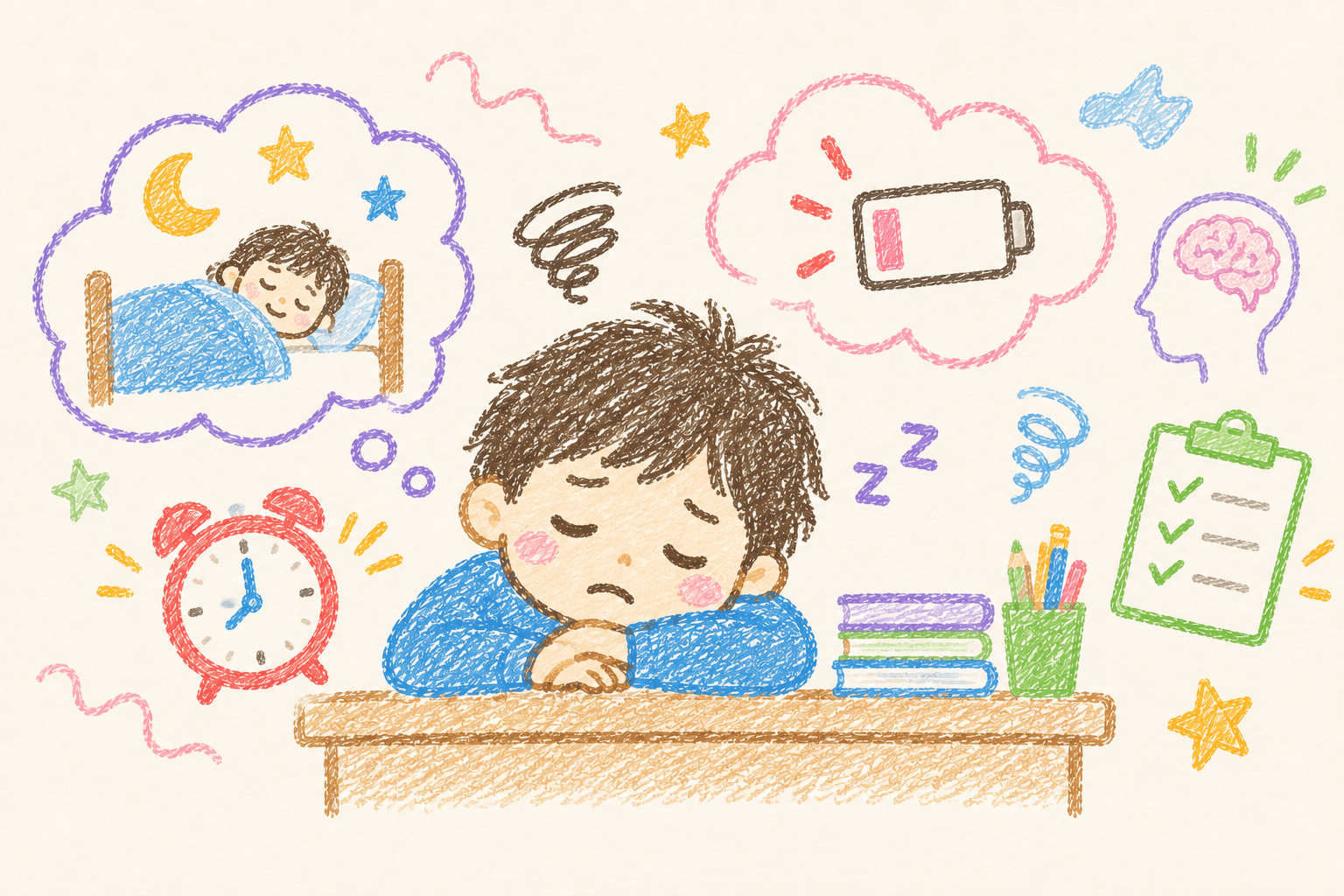
One of the things I hear most often in the clinic is this.
"My child does seem to be sleeping, but they cannot get up in the morning and keep saying they are sleepy during the day."
It is frustrating from a parent's point of view. The child is not refusing to sleep, yet their waking hours are not energetic either. Calling it simple laziness does not quite fit, because grades, mood, and even appetite are visibly affected.
After 20 years of pediatric practice, the pattern I see is that pediatric sleep deficit is more often a problem of quality than quantity. And that quality problem tends to show up as 7 daily signs.
1. Mornings take more than 30 minutes to start
The American Academy of Pediatrics (AAP) recommends 9 to 12 hours of sleep for ages 6 to 12, and 8 to 10 hours for ages 13 to 18. Even when those hours are filled, if it takes more than 30 minutes to actually get up, deep sleep (slow-wave sleep) may not be sufficient.
2. Long stretches of "spaced-out" time during the day
This often shows up between 1 and 2 p.m., right after lunch. Adults usually call it drowsiness, but children may express it differently with phrases like "I'm bored" or "Nothing is fun."
3. Frequent irritability over small things
When sleep is insufficient, connectivity between the autonomic nervous system and the prefrontal cortex weakens, making behavioral control harder. Irritability right after waking up, irritability after coming home from school, irritability the moment homework starts. If this pattern appears more than 4 times a week, it is time to review sleep.
4. Inconsistent meal timing or fluctuating appetite
Sleep and appetite share the same hypothalamic circuitry. Children with sleep deficit tend to skip breakfast, overeat at dinner, or develop a noticeable craving for sweets.
5. Reliance on caffeine or energy drinks
This signal stands out more in adolescents. One high-school senior I met in the clinic was drinking 4 to 5 caffeinated drinks a day. His distractibility was not caused by caffeine; it tagged along as he tried to cover sleep deficit with caffeine.
6. Increasing feedback from school about being "distracted"
A meaningful share of children suspected of ADHD are in fact in a chronic sleep-deficit state. Before rushing to diagnosis, keeping a sleep log for 1 to 2 weeks often reveals the pattern.
7. Sleeping 2 or more extra hours on weekends compared to weekdays
This is sometimes called "weekend sleep compensation," and it signals chronic weekday shortfall. When it repeats every week, it accumulates like a debt and recovery gets harder over time.
What parents can do day to day
Keep a sleep log for 1 to 2 weeks: Record bedtime, wake time, and daytime condition in a simple table. Patterns often emerge faster than expected.
Cut screens 1 hour before bed: This helps avoid disrupting melatonin secretion.
Limit caffeine: This includes cola, green tea, and energy drinks, and is not recommended after 2 p.m.
Keep consistent sleep and wake times: Stay within ±1 hour of weekday timing even on weekends.
If these four steps over two weeks do not change the signs, it is worth consulting a partnered clinic.
A note on SmartDream as a daily routine companion
If you are looking for a non-pharmacological option to support daily routines around sleep and attention, SmartDream is a wellness device that delivers microcurrent through a forehead patch to help balance prefrontal-related areas. It is not a medical device, so it does not replace diagnosis or treatment. It is best used alongside the daily-habit improvements above to help routines take hold.
For reference, a 6-week K-ARS follow-up of 41 children and adolescents aged 5 to 18 who used SmartDream in Dr. Sid Ryu's clinic is available on the clinical research page.
- 수면
- 집중력
- 학습
- 소아청소년정신과

Dr Sid Ryu
Pediatric psychiatrist, SmartDream developer. Read more
Explore with AI
Keep reading
ADHD daily support
Quiet ADHD Symptoms: Easy-to-Miss Signs in Children and Adults, and a Self-Check Guide
ADHD daily support
High-IQ ADHD Symptoms: Why ADHD Can Be Harder to Spot in Brighter Children
ADHD daily support
Medikinet Side Effects, How It Differs from Concerta, and What Parents Should Check First